Quick answer: A plumbing repair loan for bad credit is usually an unsecured personal installment loan used to pay a verified repair gap. If approved, it may provide a lump sum that you repay on a schedule. Before applying, stop active damage, ask for an itemized scope, check insurance and assistance, compare APR and total repayment, and test the payment against essential bills. CashLendy accepts requests up to $5,000, but approval, amount, cost, and timing are not guaranteed.
What is a plumbing repair loan?
“Plumbing repair loan” describes a use for borrowed money, not a special category of credit. In many cases it is a personal installment loan: you borrow a defined amount and repay it through scheduled installments over a stated term. The Consumer Financial Protection Bureau notes that lenders may charge fees in addition to interest and recommends comparing multiple offers.
Subject to the agreement, proceeds may help pay for diagnosis, labor, parts, permits, drain or sewer work, pipe replacement, water-heater service, access through a wall or floor, cleanup, or an insurance deductible. CashLendy is an intermediary, not a direct lender. The online form asks whether a participating lender or lending partner may respond with an offer. It is not an approval, and you do not have to accept an offer.
What a credit offer solves
A timing gap between a verified repair bill and cash you can safely use without missing essential obligations.
What it does not solve
An unknown leak, an incomplete diagnosis, an unlicensed contractor, or a payment that already exceeds the monthly budget.
What the lender decides
Whether to offer credit and, if so, the amount, APR, fees, term, payment schedule, security, and transfer timing.
What you still control
The contractor, scope, request amount, offer comparison, and final decision to accept or decline.
Plumbing emergency first: stop damage before financing
A financing application cannot stop water or sewage. Stabilize the home first. If you cannot do so safely, leave the area and call the appropriate emergency service, utility, property manager, insurer, or licensed professional. Do not enter standing water near electrical sources, touch a suspected gas leak, or open a hot pressurized system.
- Protect people. Keep children and pets away from sewage, hot water, wet ceilings, contaminated surfaces, and electrical hazards. If you smell gas or suspect a gas-line problem, leave and call the gas utility or emergency services from a safe location.
- Stop the source if safe. Use the fixture shutoff or main water valve. Turn off a leaking water heater according to its instructions only when safe. Do not make an improvised repair on gas, sewer, pressurized, concealed, or code-regulated work.
- Limit secondary damage. Move undamaged property, place a container under a small contained leak, and contact a licensed plumber. A sewer backup or major flood may also require professional cleanup.
- Document before cleanup. Photograph the source, affected rooms, damaged belongings, model or serial numbers, meter readings, and emergency actions. Save every invoice and written conversation.
- Call the insurer promptly. Ask what is covered, whether mitigation may begin, what evidence is required, how the deductible works, and whether the insurer needs to inspect before permanent repairs.
- Get a written diagnosis. Ask the plumber to separate the immediate containment, permanent plumbing fix, code work, permits, wall or floor access, restoration, and optional upgrades.
Even a small leak deserves attention. EPA WaterSense says average household leaks can waste nearly 10,000 gallons per year. That statistic does not make every drip an emergency, but it explains why a known leak should not be left open while you shop for money.
Have an itemized repair gap?
Request up to $5,000 online after you know what must be fixed and what other resources will pay.
How much do plumbing repairs cost in 2026?
Price depends on location, access, after-hours service, pipe material, permits, excavation, contamination, and the extent of hidden damage. Angi’s March 2026 cost data places many professional plumbing projects between $182 and $500, while burst pipes, main-line leaks, and related restoration can cost thousands. The ranges below are planning figures, not quotes.
| Plumbing need | Illustrative planning range | Ask whether this is included |
|---|---|---|
| Service call or diagnosis | $150–$250, often higher after hours | Trip fee, diagnostic credit, camera test, emergency premium |
| Leaking pipe | $175–$550 for accessible work | Leak detection, access, pipe material, wall repair |
| Drain snaking or clog clearing | $95–$500 | Camera inspection, hydro jetting, repeat-visit warranty |
| Toilet repair | $100–$300 | Parts, flange damage, floor damage, replacement option |
| Water-heater repair | About $150–$700 | Diagnosis, element or valve, venting, code corrections |
| Sump-pump repair | About $300–$1,000 | Backup power, check valve, basin work, discharge line |
| Burst-pipe repair | Often $1,000–$4,000 | Pipe access, drying, drywall, flooring, mold assessment |
| Main water-line leak | About $600–$4,500 | Excavation, permits, utility marking, landscaping |
| Sewer or septic repair | Often $500–$5,000+, depending on scope | Camera evidence, cleaning versus repair, trenching, cleanup |
Cost note: Ranges synthesize Angi’s 2026 plumbing cost guide and related national estimates. Your written local quote controls. Plumbing work and water-damage restoration are often separate contracts; a $500 pipe repair can sit inside a much larger drying, flooring, cabinet, or drywall project.
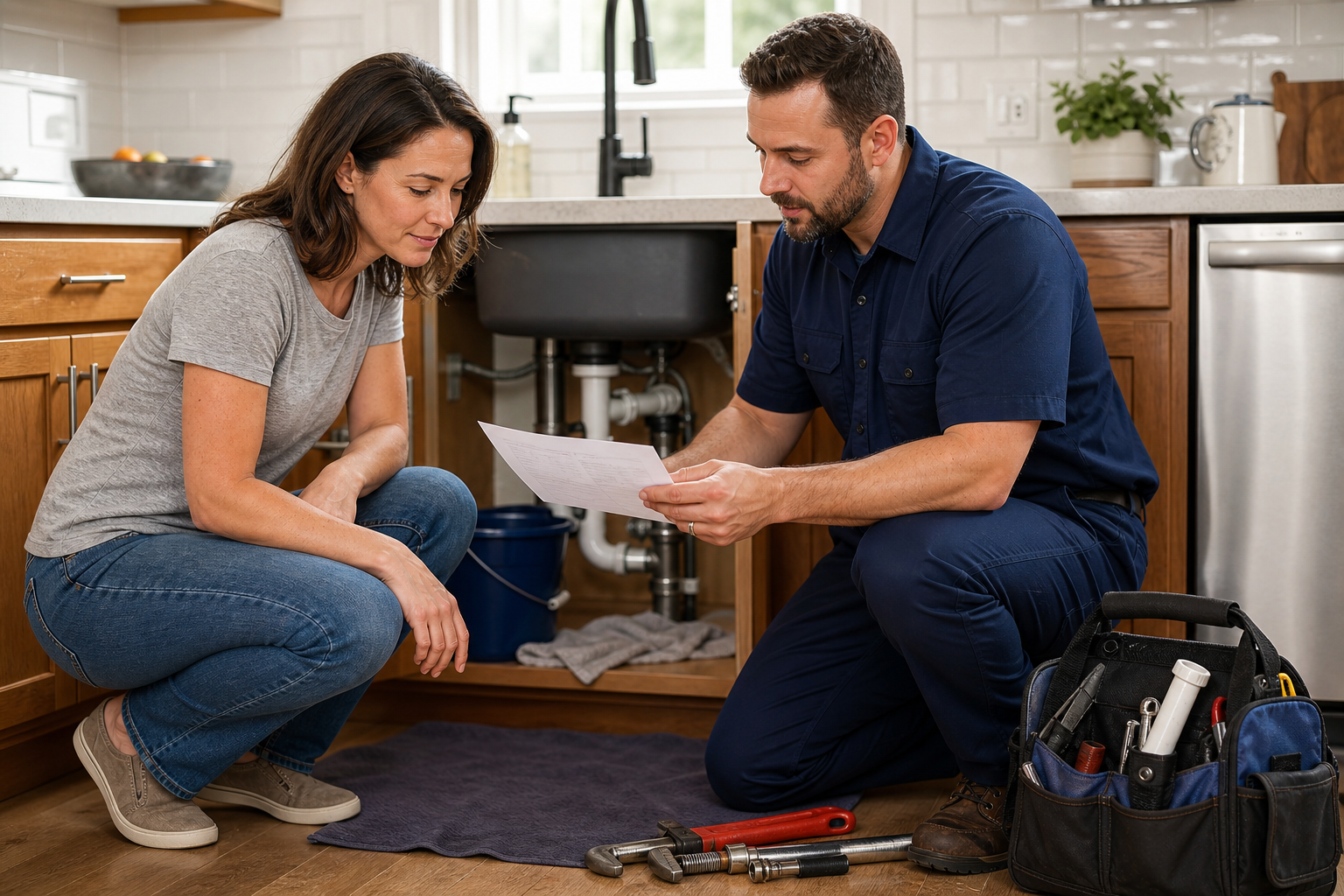
Build the real repair budget, not just the plumber’s headline price
A useful request amount begins with the total essential project, then subtracts resources you can actually use. Do not assume insurance will reimburse everything, that a contractor’s lowest number includes permits, or that restoration is part of plumbing labor.
Put these lines on one page
- Containment and diagnosis: emergency callout, leak detection, camera inspection, shutoff work, pumping, or temporary stabilization.
- Permanent plumbing repair: labor, materials, equipment, excavation, disposal, permits, inspection, and code-required work.
- Access and closure: opening and repairing drywall, cabinets, tile, slab, ceiling, landscaping, or pavement.
- Water or sewage restoration: extraction, drying, sanitation, damaged materials, temporary storage, and mold assessment when appropriate.
- Insurance position: deductible, excluded work, coverage limit, recoverable depreciation, reimbursement timing, and emergency mitigation authorization.
- Household continuity: safe lodging, meals, laundry, or transportation only when genuinely caused by the loss and not otherwise covered.
- Cash protection: leave enough for food, utilities, housing, insurance, transportation, medication, existing debt, and the first new payment.
For example, suppose the permanent pipe repair is $1,650, necessary wall access and closure is $650, and cleanup is $700. The $3,000 project may be partly covered by insurance, but the policy has a $1,000 deductible and excludes the worn pipe itself. If confirmed insurance pays $1,300, safe savings provide $500, and the contractor accepts $300 later, the remaining gap is $900—not the full $3,000.
If the written gap is above $5,000, do not split it into several expensive loans without a complete plan. Ask whether the project can be safely phased, whether insurance or a public program applies, and whether a lower-cost home-improvement or secured option is appropriate. For broader projects, see our guide to home repair loans for bad credit.
Know the smallest amount that works?
Use the verified gap—not the contractor’s full headline price—when making a request.
Compare plumbing financing options in the right order
The fastest option is not automatically the least expensive, and the lowest advertised payment is not automatically the safest. Compare the resources you qualify for in writing.
| Option | Potential advantage | Important tradeoff |
|---|---|---|
| Insurance claim | May cover sudden resulting damage and emergency mitigation | Deductible, exclusions, limits, cause-of-loss rules, and reimbursement timing apply |
| Contractor payment plan | May align payment with project milestones or reduce the amount borrowed elsewhere | Terms vary; confirm APR, fees, lien language, and who actually provides credit |
| Unsecured personal installment loan | Defined amount and scheduled payments without pledging the home in many cases | Bad credit may mean a smaller amount or higher cost; approval is not guaranteed |
| Credit card | Existing credit can pay an urgent smaller bill; a genuine 0% offer can be useful | Variable rates, utilization, deferred-interest terms, and a balance that stays open to new spending |
| Home equity loan or HELOC | May offer a lower rate for a large planned project | The home secures the debt; closing, appraisal, draw, and variable-rate risks may make it unsuitable for a fast small repair |
| HUD Title I improvement loan | FHA-insured lender option for qualifying property repairs and improvements | Private lender underwriting applies; balances above $7,500 must be secured by the property |
| USDA Section 504 | Qualifying very-low-income rural homeowners may access a 1% repair loan; some older owners may qualify for grants | Location, income, ownership, occupancy, credit-access, and program processing requirements apply |
| Local housing or nonprofit aid | May provide grants, forgivable loans, emergency repair help, or vetted contractors | Funding, wait times, eligible repairs, geography, age, disability, and income limits vary |
| Payday or title loan | Advertised as fast and accessible | Potentially very high cost, short payoff pressure, rollover risk, or loss of the vehicle; compare safer alternatives first |
A renter should notify the landlord or property manager immediately and follow the lease and local law before hiring permanent work. A tenant may be responsible for damage they caused, but the property owner generally controls building systems. Keep written notice, photographs, and receipts; contact local housing or legal-aid resources if habitability or retaliation becomes an issue.
How bad credit changes a plumbing loan request
There is no universal score that guarantees a plumbing loan. Different lenders use different models. Credit history may matter, but recurring income, payment obligations, bank-account activity, recent inquiries, requested amount, state eligibility, identity verification, and the ability to repay may also affect a decision.
Request the documented gap
A smaller, exact request can be easier to carry than borrowing for every possible repair and upgrade. It still does not guarantee approval.
Use accurate income
List only income you can document and are allowed to include. Never inflate pay, omit debts, or alter bank records.
Reduce avoidable errors
Match your legal name, address, phone, bank information, and employer details. Inconsistencies can slow verification.
Check your reports
Use AnnualCreditReport.com and dispute genuine errors with the bureau showing them. Do not pay a stranger to create a new credit identity.
CashLendy states that submitting its request does not affect your credit score. A participating lender may use a soft inquiry for an initial review, while accepting or completing an offer may involve a hard inquiry. Read the authorization before continuing. If several providers allow prequalification with a soft inquiry, compare within a focused period rather than submitting scattered applications without understanding the effect.
Bad credit does not prevent a careful request
Use accurate information, ask for the verified gap, and review any offer before accepting.
Can a plumbing repair loan arrive the same day?
It may be possible in some cases, but “same day” is not a promise of approval or deposit. Timing usually depends on when you apply, whether a lender responds, identity and income verification, document accuracy, electronic signing, lender and bank cutoffs, transfer method, weekends, holidays, and the receiving bank.
- Stabilize. Stop active damage and call the appropriate professional.
- Document. Get an itemized diagnosis, due date, and insurance position.
- Request. Submit complete, accurate information for the verified gap.
- Compare. Read APR, fees, net proceeds, payment, term, and total repayment.
- Coordinate. Confirm deposit and contractor timing before promising payment.
Do not tell a plumber that money is guaranteed until it is actually available. Ask whether a temporary safe repair, card hold, deposit, insurer authorization, or milestone schedule can prevent extra damage while financing is pending. A fast deposit that arrives after the contractor leaves does not solve the emergency.
Compare the entire loan offer, not one payment
APR combines interest and certain finance charges into a yearly measure, making it more useful than the interest rate alone. Also compare the dollar payment and total amount repaid. The lowest monthly payment can be the most expensive offer if it stretches the balance across many more months.
- Approved amount and net proceeds: An origination fee may be deducted before money reaches you. Make sure the net amount covers the verified gap.
- APR and finance charge: Compare the yearly cost measure and the total dollar cost, not an advertised rate without context.
- Payment schedule: Confirm amount, frequency, first due date, final date, and whether the payment can change.
- Total of payments: Add every scheduled payment and disclosed fee. Use the CashLendy loan calculator to test scenarios, then rely on the actual agreement.
- Late and returned-payment terms: Know fees, grace periods, collection actions, and possible credit reporting.
- Prepayment: Ask whether extra principal reduces cost and whether any prepayment penalty applies.
- Automatic debit: Understand the authorization, withdrawal date, insufficient-funds risk, and cancellation method.
- Security and liens: Do not assume contractor-arranged financing is unsecured. Read any home, vehicle, or mechanic’s-lien language.
Three illustrative payment examples
These calculations assume fixed monthly payments, no added fee, and the APR shown. They are educational examples, not CashLendy offers or rate predictions.
| Amount and term | Illustrative APR | Approximate payment | Approximate total |
|---|---|---|---|
| $1,200 for 12 months | 18% | $110.02 | $1,320.19 |
| $2,500 for 18 months | 36% | $181.77 | $3,271.89 |
| $4,000 for 24 months | 60% | $289.88 | $6,957.21 |
The third example turns a $4,000 repair into nearly $7,000 of payments. That does not mean every bad-credit offer costs 60%; it shows why urgency must not replace comparison. If the payment competes with housing, utilities, food, insurance, transportation, medication, or existing debt, the repair may need a different funding mix.
How to choose the plumber and protect the contract
An urgent leak may not allow three full competitive bids before containment. You can still verify the permanent repair. The FTC advises checking licenses and insurance, obtaining multiple written estimates when possible, reading the contract, and avoiding full payment up front.
- Verify the business. Confirm the legal name, physical address, phone, state or local license where required, insurance, and the person who will perform the work.
- Ask for diagnostic evidence. Photos, video, meter tests, pressure tests, or camera footage should support major demolition, excavation, repiping, or sewer recommendations.
- Separate phases. The estimate should distinguish containment, plumbing repair, permits, access, restoration, and optional upgrades.
- Compare like with like. One low bid may exclude permits, drywall, disposal, fixtures, cleanup, or warranty. Ask why estimates differ.
- Read the payment schedule. Tie payments to documented milestones. Do not pay the full project in cash before work begins, and keep proof of every payment.
- Control changes. Require a written change order describing the new finding, price, timing, and effect on the warranty before extra work proceeds, except immediate safety containment.
- Close the job properly. Keep the final invoice, permit signoff, warranty, photographs, product information, lien release where appropriate, and insurer documents.
Be cautious if the contractor insists you use a particular lender, asks you to sign blank documents, says the price is available only right now, wants you to misstate the purpose of funds, or suggests putting the house at risk without time to review. Financing and repair are separate decisions even when one company presents both.
Insurance and lower-cost repair programs to check
Borrowing should fill the remaining gap after resources you genuinely qualify for, not replace them without checking. Availability and speed vary, so an active hazard may still need immediate mitigation.
Homeowners or renters insurance
Ask whether sudden resulting damage, emergency mitigation, temporary housing, or damaged belongings are covered. The failed part itself or gradual leakage may be excluded.
HUD Title I
FHA-insured private lenders may finance qualifying property improvements. Rates are negotiated, underwriting applies, and balances above $7,500 require property security.
USDA Section 504
Eligible very-low-income rural homeowners may use 1% loans for repairs and health or safety hazards; qualifying homeowners age 62 or older may be eligible for grants.
City, county, tribe, or nonprofit
Search for emergency home repair, aging-in-place, weatherization, disability-access, sanitation, water-conservation, or owner-occupied rehabilitation programs.
Ask the water utility whether a documented repaired leak can qualify for a bill adjustment and whether it offers a fixture, service-line, or income-based program. If the leak created a water bill you cannot pay, contact the utility before the due date and review our guide to utility bill help and financing. FEMA help is tied to eligible damage from a presidentially declared disaster and is not a general maintenance program; insurance and other assistance are considered.
How to request a plumbing repair loan online
- Stabilize and diagnose. Stop active damage and obtain an itemized estimate or an emergency invoice plus the expected permanent scope.
- Calculate the smallest gap. Subtract confirmed insurance, aid, contractor terms, and safe cash. Remove optional upgrades.
- Test the payment. Use several realistic APR and term scenarios. Leave room for ordinary household bills and a repair overrun.
- Gather accurate details. Have identification, address, contact, income, employment, bank, and expense information ready. Requirements vary.
- Submit the online request. CashLendy accepts requests up to $5,000. Use a secure connection and review consents before sending data.
- Review the response. A response is not automatically a good offer. Compare the amount, net proceeds, APR, fees, payment, term, total repayment, debit authorization, and lender identity.
- Coordinate payment only after funding. Confirm the bank deposit and the plumber’s accepted payment method. Keep the loan agreement and contractor receipt separately.
Build repayment around the repaired home
The first payment can arrive while you are still replacing drywall or disputing an insurance item. Add the new payment to the real post-repair budget before accepting.
- Protect the payment date. Place it after dependable income when possible and set reminders before any automatic debit.
- Keep an account cushion. A payment that triggers overdraft or a returned-payment fee costs more than the stated installment.
- Track reimbursements. If insurance later pays a covered item, decide whether the agreement lets you reduce principal without penalty rather than spending the reimbursement elsewhere.
- Save the repair records. Keep the diagnosis, contract, invoice, photos, permit, warranty, insurance decision, and loan documents in one folder.
- Prevent the next loss. Label shutoff valves, inspect supply lines, monitor unusual meter movement, maintain the water heater and sump pump, and address recurring clogs or pressure problems.
- Contact the lender early. If a payment problem appears, ask about available options before the due date. Do not cover one unaffordable loan with another without advice and a full plan.
Plumbing loan and contractor scam red flags
Emergencies create pressure, and scammers exploit it. Protect both transactions: the credit agreement and the repair contract.
Guaranteed approval
No legitimate provider can promise every applicant a particular amount, APR, or same-day deposit before review.
Advance fee to release money
The FTC warns that a demand for “processing,” “insurance,” or another payment to unlock a promised loan is a scam.
Blank financing papers
Never sign an incomplete agreement, let someone rush past disclosures, or hand over login credentials for them to apply as you.
Cash-only full payment
Pressure to pay the entire project before work, especially in cash or by wire, removes leverage and proof.
Sudden expensive diagnosis
Pause when major excavation or repiping is proposed without evidence, an itemized scope, or a reasonable chance for another opinion.
Contractor-selected risky loan
Do not pledge your home, accept a high-cost loan, or sign a lien merely because the contractor says financing is routine.
Gift cards, crypto, or secret payment
These methods are not normal ways to release loan funds, pay a licensed plumber, or preserve consumer protections.
License or identity mismatch
Stop when the business name, license, website, phone, bank recipient, invoice, and worker identity do not align.
Frequently asked questions
Can I get a plumbing repair loan with bad credit?
You may be able to request one, but approval, amount, APR, terms, and funding time are never guaranteed. Lenders may consider recurring income, existing debts, credit history, bank activity, state eligibility, the requested amount, and other factors.
How much can I request for a plumbing repair through CashLendy?
CashLendy accepts online personal loan requests for up to $5,000. A participating lender or lending partner decides whether to make an offer and determines the approved amount, APR, fees, repayment schedule, and other terms.
Can plumbing repair money arrive the same day?
Same-day funding may be possible in some cases, but it is not guaranteed. Approval, verification, signing time, lender cutoffs, weekends, holidays, transfer method, and the receiving bank all affect timing.
What plumbing expenses could a personal loan cover?
Subject to the agreement, proceeds may cover lawful personal expenses such as diagnosis, labor, parts, permits, pipe or fixture repair, drain or sewer work, water-heater service, access repairs, cleanup, or an insurance deductible. Verify lender restrictions first.
Does homeowners insurance cover plumbing repairs?
Coverage depends on the policy and cause. A policy may cover sudden resulting water damage while excluding the worn pipe, gradual leakage, maintenance, sewer backup without an endorsement, or damage below the deductible. Stop the leak, document the damage, and ask the insurer promptly.
Will checking plumbing loan options affect my credit score?
CashLendy states that submitting its request does not affect your credit score. A lender may use a soft inquiry initially, while accepting or completing an offer may involve a hard inquiry. Read the authorization and disclosures.
Should I finance the plumber’s entire estimate?
Usually it is safer to request only the verified remaining gap after insurance, assistance, a contractor payment plan, and safe savings. Include essential related work, remove optional upgrades, and keep cash for household bills and the first payment.
What is the biggest plumbing loan or contractor scam warning?
Do not pay an upfront fee to unlock a promised or guaranteed loan, and do not sign blank financing or contractor documents. High pressure, cash-only full payment, unverifiable licenses, unexplained scope changes, gift-card or crypto demands, and risky home-secured credit are serious warnings.
Sources and further reading
- Consumer Financial Protection Bureau: What is a personal installment loan?
- Consumer Financial Protection Bureau: Interest rate versus APR
- Consumer Financial Protection Bureau: Personal installment loan fees
- U.S. Environmental Protection Agency WaterSense: Free of Water Leaks technical sheet
- Angi: How much does plumbing repair cost? 2026 data
- U.S. Department of Housing and Urban Development: Title I Property Improvement Loans
- USDA Rural Development: Section 504 Single Family Housing Repair Loans and Grants
- Federal Trade Commission: How to avoid a home improvement scam
- Federal Trade Commission: What to know about advance-fee loans
- AnnualCreditReport.com: Federally authorized credit report access
Bottom line
A plumbing repair loan for bad credit can be useful when water, sewage, hot-water, or pipe damage creates a verified shortfall that cannot safely wait. It is a poor fit when the problem is undiagnosed, the contractor cannot be verified, insurance or assistance has not been checked, the amount includes optional upgrades, or the payment would displace essential bills.
Stop the source, document the loss, get an itemized scope, calculate the smallest gap, compare the complete credit disclosure, and keep control of the decision. If an offer is available, you can review it without being required to accept it.
Ready to check plumbing repair loan options?
Request up to $5,000 online and review any available offer carefully before deciding.


